



How can beginner gardeners create a thriving vegetable patch?
“Mary, Mary, quite contrary, how does your garden grow?” begins the infamous Mother Goose nursery rhyme for children, which is a good question to start with for any beginning gardener, no matter what their age. If you’d like to get into gardening this summer, here are a few essential tips that all new gardeners should learn in order to grow a successful vegetable garden, whether planted directly in the ground or in containers.
Get the most out of gardening’s 4 basic elements
Soil
The first thing you need to consider is the type of soil you will be using to plant your vegetables and herbs. Whether you’re using containers or planting directly into the ground, choose a high-quality garden soil containing moss and mix it with compost. The ideal blend is half and half. This mix will provide the nutrients needed by plants to support their growth.
If you’re gardening directly in the ground, you will probably need to add garden soil and compost, since “virgin” soil is usually not adequate for growing vegetables. Also make sure the ground is level to allow maximum penetration of water into the ground.
Sun
The sun is the source of all life on Earth, and the amount of direct sunshine your plants receive will determine the success of your garden. You should therefore choose a position for the vegetable plot that receives the most sun exposure during the day, whether south or south-west. You should aim for at least 6 hours of direct sun per day, unless you are growing leafy vegetables, which will be fine with 4 to 6 hours.
Water
For crisp vegetables, frequent watering is needed as soon as the soil starts to dry out. During heatwaves when the sun is beating down on your plants, consider watering both morning and evening. Otherwise, daily watering will be enough for fine summer days, or even two waterings a week. The key is to keep the soil moist without being completely soaked. Unsurprisingly, container gardens dry out more quickly than gardens planted directly in the ground, so keep an eye on those containers!
If possible, water the garden in the morning. This allows the leaves to dry off, thereby avoiding fungal diseases. Obviously, a hard rain will give you a break from having to water! And on this subject, you should know that rainwater is the best type of water for your plants, so you could consider picking up a rain barrel to collect rainwater (plus, it’s environmentally friendly!).
Wind
While air is also essential to the survival of plants, strong winds, on the other hand, may damage them. You should therefore shelter the garden from blustery weather.
Article Description
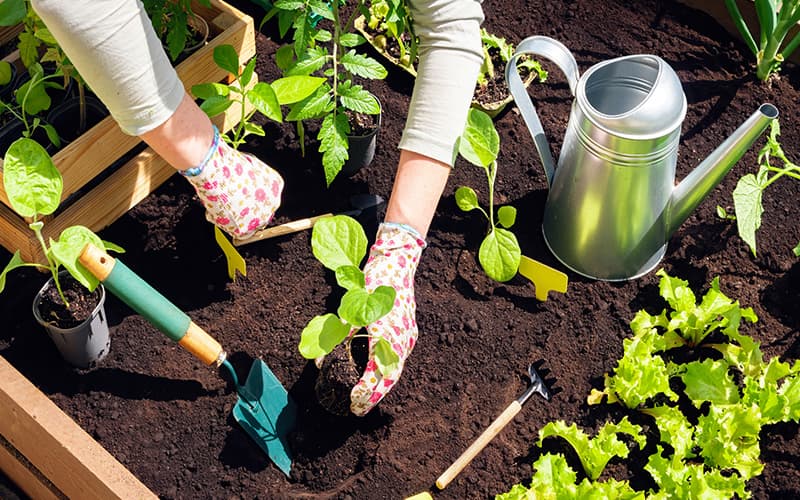
Various ways of creating a vegetable patch
Various ways of creating a vegetable patch
There are many styles of vegetable garden. Here are the most common.
Raised beds
Raised beds
Easy to maintain, planter boxes let you grow your vegetables in elevated planters, making them easy to reach and avoiding the necessity of having to bend over or get onto your knees. Some models are even equipped with drainage and watering systems, which greatly helps beginners grow successful crops, even if they make a few mistakes along the way. What’s more, they can easily be installed on balconies and patios.
Raised beds are based on the same principle, except that these are in the form of a few feet of earth mounded above ground level and buttressed usually by wood. Here, various types of plants can harmoniously share the same space.
Lastly, consider also using grow bags. Besides being affordable, they facilitate aeration of the soil and the development of the plants’ root systems through the use of permeable geotextiles.
Row gardens
Row gardens
As you’ve no doubt seen countless examples of, row planting involves planting the same species in a row of arbitrary length. A row garden can be made up of as many rows as desired, with a few feet of space between to allow you to move around them.
Plot cultivation
Usually directly on the ground, plots are areas demarcated using wooden planks arranged in various shapes (squares, rectangles and even triangles) and sizes. Most of the time a single species is grown in each plot.
Naturally, plot cultivation such as a row garden will first necessitate removing the turf and working the soil to a depth of 12 inches.
Small garden, big results!
Small garden, big results!
To ensure your first experience is positive so you’ll want to try it again next year, start with a reasonably sized garden: It will take less time to maintain, and you’ll maximize your chance for success. To be able to enjoy home-grown veggies during the hot weather, two or three beds or the same number of planter boxes will be enough for two adults and two children. Leave dreams of self-sufficiency to the more experienced gardeners!
A few herbs and vegetables that are easy to grow
A few herbs and vegetables that are easy to grow
These plants grow so quickly and easily you can practically see them growing. You can find most of them at an IGA store.
- “Celebrity” red tomatoes
- “Sugar Rush” and “Baby Boomer” red cherry tomatoes
- Nantes carrots
- Radishes
- Zucchini
- Leaf lettuce
- Spinach
- Small white onions
- Baby turnips
- Chives
- Mint
- Thyme
- Rosemary
- Parsley
- Cilantro
- Lavender
Don’t hesitate to grow tomatoes and herbs in pots—they’re as practical as they are decorative!
Is garden fertilizer necessary?
Is garden fertilizer necessary?
The vast majority of vegetables will need fertilizer to grow normally. One month after planting, you should add a garden fertilizer that contains the nutrients and minerals required by your chosen vegetables. If you opt for a natural fertilizer, you’ll need to reapply it each month. For synthetic fertilizers, application every 15 days is recommended.
Although it sometimes gets bad press, this type of fertilizer, commonly called chemical fertilizer, is safe health-wise. It is, however, recommended to choose a fertilizer that is natural and organic, and more respectful of the environment.
If the idea of having to fertilize bothers you, try growing root vegetables and lettuces, which will grow happily without it!
A few myths
A few myths
Simon Lapointe busts a few myths about fertilizers.
Eggshells
It is incorrect to believe that eggshells contain enough nutrients to fertilize soil.
Coffee grounds
“In addition to not really nourishing the soil, they retail moisture, which is likely to create a problem!” he warns.
Milk
Never mist your garden with milk! “Your plants don’t absorb calcium from milk like humans do,” explains Lapointe.
Seeds: A grain of truth
Seeds: A grain of truth
Starting your garden from seeds is an art in itself and requires a certain basic understanding of horticulture. Plus, you need to plan well in advance! New gardeners should instead start off by using baby plants that only need to be dug into the ground.
A gardener’s toolbox
A gardener’s toolbox
To facilitate endless hours of gardening, consider putting together a set of essential gardening tools. Gloves, a three-pronged rake, watering can, hoe, pruning shears, etc. Learn more about these gardening allies in this article.
Feed your passion with tons of food tips sent right to your inbox.
Sign up for our newsletter full of recipes, cooking tips, inspirational content and more.
Sign up